
Key Takeaways:
What Does the RoHS Compliance in PCB Design Entail?
- RoHS compliance limits the use of hazardous substances in PCBs to protect human health, the environment, and enable global market access.
- Compliance affects core PCB design decisions, including materials, soldering methods, and component selection, not just final manufacturing checks.
- Material and component selection requires verified RoHS certification and clear supply chain traceability to prevent late-stage compliance gaps.
- Integrating RoHS requirements early in the design process reduces regulatory risk, avoids redesigns, and supports reliable, compliant PCB production.
Introduction
As regulatory requirements, environmental responsibility, and global market expectations continue to evolve, the Restriction of Hazardous Substances (RoHS) compliance has become a fundamental consideration in modern printed circuit board (PCB) design. The directive sets clear limits on the use of specific hazardous substances in electronic products, which has practical implications for how PCB projects are planned and managed.
This article explores the importance of RoHS compliance in PCB design and how it shapes key design and manufacturing decisions.
What is RoHS Compliance in PCB Design?
RoHS is a regulatory framework introduced by the European Union (EU) to limit the use of certain hazardous materials in electrical and electronic products, including PCBs. It ensures that boards are manufactured without substances that pose long-term risks to human health or the environment.
While RoHS is an EU directive, many markets have RoHS-aligned substance restrictions or customer requirements that mirror EU expectations. EU RoHS currently restricts 10 substances in total:
- Lead (Pb)
- Mercury (Hg)
- Cadmium (Cd)
- Hexavalent chromium (Cr⁶⁺)
- Polybrominated biphenyls (PBB)
- Polybrominated diphenyl ethers (PBDE)
- DEHP (Bis(2-ethylhexyl) phthalate)
- BBP (Benzyl butyl phthalate)
- DBP (Dibutyl phthalate)
- DIBP (Diisobutyl phthalate)
Why RoHS Matters Beyond Regulation
While RoHS originated as a European directive, its impact extends far beyond regulatory paperwork. Designing compliant PCBs allows manufacturers to access international markets without redesigns or delays. It also signals responsible engineering practices to clients, partners, and end users.
1. Addressing the Risks of Hazardous Materials in Electronics
An important factor is the growing awareness of hazardous materials in electronics. Non-compliant boards may expose workers, users, and recyclers to toxic substances over time. From an environmental and operational perspective, RoHS compliance reduces long-term risk and supports sustainable manufacturing practices.
2. Transitioning to Lead-Free PCB Manufacturing
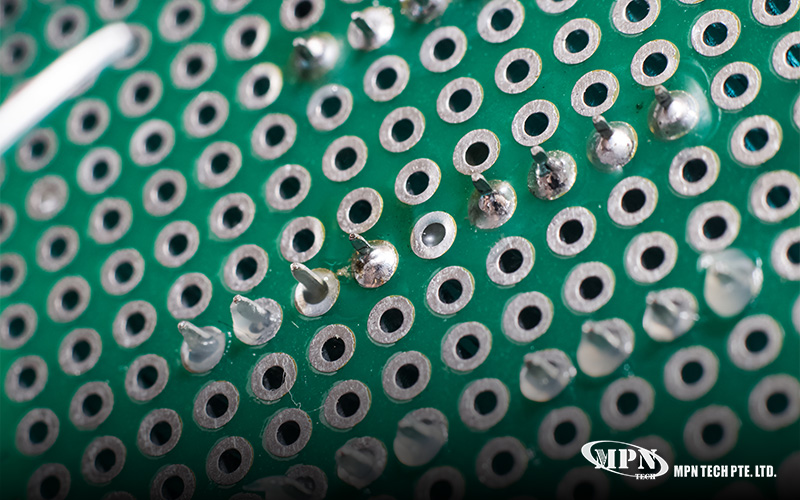
Another key change introduced by RoHS is the shift towards lead-free PCB manufacturing. Traditional solder alloys relied heavily on lead due to its low melting point and favourable mechanical properties. RoHS-compliant designs require alternative solder compositions, commonly based on tin, silver, and copper.
3. Design Considerations When Using Lead-Free Solders
Lead-free solders generally require higher soldering temperatures compared to traditional tin-lead alloys. For example, eutectic SnPb solder melts at about 183 °C, while commonly used lead-free SnAgCu alloys melt around 217–219 °C. Designers must account for these factors to prevent issues such as thermal stress, warping, or reduced component reliability.
What to Take Note of in Material and Component Selection
Achieving compliance goes beyond solder choice. PCB material compliance involves ensuring that laminates, surface finishes, and components meet RoHS requirements. This includes verifying that suppliers provide certified documentation for substrates, finishes, and assembled parts.
During the design phase, engineers should prioritise components with verified RoHS certification and ensure traceability throughout the supply chain. For teams working on PCB design projects in Singapore, facilitating effective communication with manufacturers and suppliers helps reduce the risk of compliance gaps emerging later in the production process.
How to Ensure RoHS Compliance in PCB Design
Successful compliance depends on process discipline because compliance risks often emerge early in design. When RoHS considerations are integrated into schematic design, layout decisions, and material sourcing, engineers can avoid selecting components or materials that later require substitution, redesign, or requalification. This early integration reduces the likelihood of production delays and costly changes, once the design is already locked in.
Supplier verification is equally important, as compliance is only as reliable as the documentation supporting it. Designers and engineers need confirmed certification and testing records to ensure that materials and components meet regulatory requirements. Without proper verification, compliance gaps may only surface during audits or export approvals, creating operational and regulatory risks.
In addition, material substitutions introduced to meet RoHS requirements can affect electrical performance, thermal behaviour, or manufacturability. Designers must understand these impacts to avoid unintended reliability issues, including increased thermal stress or reduced solder joint integrity. Prototyping and validation allow teams to confirm that compliant designs perform as intended under real operating conditions.
A Balanced Perspective on RoHS Constraints
It is worth noting that RoHS compliance can introduce trade-offs. Lead-free processes may increase manufacturing complexity or costs, particularly for high-reliability or high-temperature applications. However, these challenges can often be outweighed by the benefits of regulatory alignment, broader market access, and reduced environmental impact.
As an experienced PCB design company in Singapore, MPN Tech integrates regulatory considerations directly into its PCB design and manufacturing workflows. We ensure our designs meet compliance requirements and remain reliable for global deployment.
Contact us for support with RoHS Compliance in PCB Design.
 MPN Tech