
Introduction
From smartphones to satellites, modern life runs on electronics. These devices drive everything from how we communicate and navigate to how we diagnose illnesses or explore space. Driving all this innovation is the printed circuit board (PCB), quietly working behind the scenes to link and power the components that keep devices running smoothly.
However, building a reliable PCB doesn’t happen by chance. It requires strict adherence to a universal playbook: IPC standards. Short for the Institute for Printed Circuits, IPC sets the global gold standard for how PCBs should be designed, manufactured, and tested.
Let’s discover how IPC Standards for PCB Manufacturing support manufacturers in building electronics that work flawlessly from the inside out.
Key Takeaways:
What Sets the Global Benchmark for PCB Quality?
The global benchmark for PCB quality is established through IPC standards. These frameworks outline best practices for every stage of PCB production to ensure consistency, safety, and reliable performance across the electronics sector.
How Do IPC Standards Improve Quality and Efficiency?
Following these industry frameworks reduces production errors, prevents costly rework, and streamlines workflows.
Why Are There Different PCB Quality Classes?
IPC-6011 categorises PCBs into Class 1, 2, and 3 based on reliability and application needs—from basic consumer electronics to life-critical systems like medical and aerospace devices.
Which Guidelines Apply to Each Stage of PCB Manufacturing?
Key documents such as IPC-A-600, IPC-A-610, IPC-2221, and IPC-7351 offer clear criteria for everything from bare board inspection to layout design and component mounting.
What Does It Take to Maintain Compliance?
Ensuring adherence involves working with certified partners, using approved design tools, staying updated on new editions, and fostering cross-functional team alignment.
What Role Do PCB Suppliers and Assemblers in Singapore Play?
Leading PCB suppliers and assembly companies adopt IPC-aligned practices to deliver high-quality, globally competitive products. Their commitment to these standards ensures reliable performance, faster turnaround, and compliance with international requirements.
How Do IPC Guidelines Support Global Manufacturing?
They ensure seamless collaboration between international stakeholders, improving supply chain efficiency and product compatibility across regions.
Understanding IPC Standards
What Are IPC Standards?
IPC, originally known as the Institute for Printed Circuits, is now formally recognised as IPC – Association Connecting Electronics Industries. It is a globally respected trade association that sets the benchmark for excellence in the electronics manufacturing industry.
IPC standards are internationally accepted guidelines that govern the design, fabrication, and assembly of PCBs and other electronic assemblies. They ensure uniformity, safety, and high-quality output across every stage of electronic production.
Developed through a collaborative process, IPC standards are created and maintained by industry-driven committees made up of engineers, designers, OEMs, and manufacturers. Today, more than 3,000 professionals from around the world contribute their expertise to shaping and refining these guidelines, keeping them relevant in the industry.
Understanding how to stay IPC compliant is key to maintaining high quality and adhering to industry standards. This involves continuous staff training, regular quality audits, and keeping up with the latest IPC updates and classifications.
Why Do IPC Standards Matter in PCB Manufacturing?
After understanding what IPC standards are, we’ll now explore why these standards play such a part in the PCB manufacturing process. On top of meeting PCB design guidelines, IPC offers several benefits that directly impact product quality, production efficiency, and business growth.
1. Reduce Errors and Rework
By providing clear and detailed manufacturing guidelines, IPC standards help minimise common issues like design flaws, assembly errors, and performance failures. This not only lowers the risk of costly product recalls but also reduces the need for time-consuming rework.
2. Improve Compatibility
These standards create a shared framework for communication among designers, engineers, component suppliers, and manufacturers worldwide. This consistency ensures that all parties are aligned, making it easier to manage cross-border production and component sourcing.
3. Streamline Production
Standardised procedures help manufacturers establish more efficient workflows, facilitate better documentation, and improve communication across departments. The result is faster prototyping, smoother production runs, and quicker delivery to market.
For instance, by integrating IPC-compliant design and assembly practices early in the process, manufacturers can avoid miscommunication between design and production teams. This alignment helps eliminate unnecessary revisions, reduces delays, and speeds up the overall time-to-market.
4. Enhance Market Competitiveness
Compliance with IPC standards demonstrates a commitment to quality—something many international clients, industries, and government agencies specifically look for. For example, it can give PCB board manufacturers in Singapore a competitive edge when bidding for global contracts or entering regulated markets.
Key IPC Standards in PCB Manufacturing
What You Need to Know about IPC Standards
IPC has developed a wide range of standards to guide every stage of PCB design, manufacturing, inspection, and repair. Each standard addresses a specific aspect of the process, helping manufacturers produce consistent, high-quality circuit boards that meet global expectations.
In this section, we will outline some of the most widely used IPC standards that professionals across the electronics industry rely on:
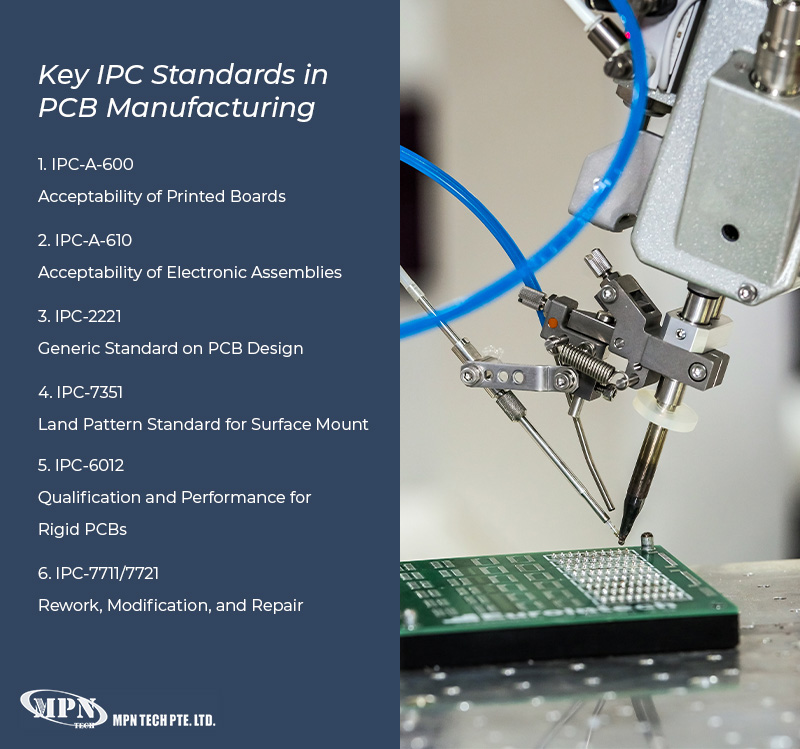
1. IPC-A-600 – Acceptability of Printed Boards
IPC-A-600 sets the benchmark for the visual inspection of bare PCBs. It highlights the criteria for identifying and classifying surface and internal defects, including pits, scratches, inclusions, and delamination. Quality control teams commonly use this standard to assess whether a PCB meets required quality levels before assembly begins.
2. IPC-A-610 – Acceptability of Electronic Assemblies
Focusing on completed PCB assemblies, IPC-A-610 is used to verify the final quality of soldering, cleanliness, and component alignment. It’s a key resource for inspectors and quality assurance teams, ensuring uniformity in production and helping manufacturers maintain consistent standards across different batches.
3. IPC-2221 – Generic Standard on PCB Design
IPC-2221 provides general design guidelines for PCBs, addressing key factors such as layout, material selection, electrical clearances, and conductor spacing. By following this standard, designers can improve manufacturability and reduce the risk of design-related errors, resulting in more efficient and reliable PCB fabrication.
4. IPC-7351 – Land Pattern Standard for Surface Mount Devices (SMDs)
This standard defines the recommended pad shapes and dimensions for surface mount components. IPC-7351 is essential for achieving accurate component placement, strong solder joints, and overall reliability in PCB assembly. It also supports efficient CAD library creation, streamlining the design-to-manufacture process.
5. IPC-6012 – Qualification and Performance for Rigid PCBs
IPC-6012 specifies the mechanical, thermal, and electrical performance requirements for rigid printed circuit boards. It’s often adopted to certify that boards can operate reliably under real-world conditions, making it crucial in sectors like automotive, industrial, and aerospace electronics.
6. IPC-7711/7721 – Rework, Modification, and Repair
These standards provide step-by-step guidance for reworking, modifying, or repairing PCBs after production. They are vital in industries where high-value boards need to be maintained or updated over time, such as in medical or aerospace applications. Following these guidelines ensures that rework does not compromise the board’s structural or functional integrity.
What are IPC PCB Classifications?
Now that we’ve covered key IPC standards and their roles in PCB fabrication, let’s explore how IPC classifies circuit boards based on their intended use and performance expectations. These classifications, defined under IPC-6011, help manufacturers and clients align on the required level of quality and reliability for a specific application.
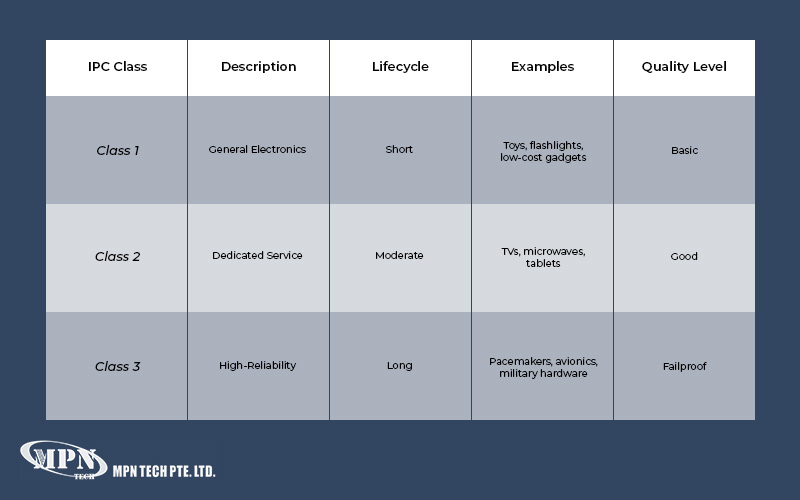
IPC classifies PCB quality into three levels—Class 1, 2, and 3—based on reliability, performance requirements, and application criticality.
Class 1: General Electronic Products
This is the entry-level classification, intended for products where basic functionality is sufficient and long-term performance is not a key concern. It prioritises cost-effectiveness over long-term durability.
Use Cases: Low-cost consumer electronics such as toys, novelty items, and disposable gadgets.
Quality Expectations: The lowest level of inspection is applied. Minor cosmetic or structural defects are acceptable as long as they don’t impact basic functionality.
Class 2: Dedicated Service Electronic Products
Class 2 is intended for products that need reliable, long-term performance under standard operating conditions. It offers a middle ground between quality and cost, making it ideal for devices that must function reliably but aren’t used in life-or-death situations.
Use Cases: Office equipment, home appliances, industrial controllers, and most consumer electronics.
Quality Expectations: Allows minor cosmetic imperfections but maintains tighter control over electrical performance and reliability.
Class 3: High-Reliability Electronic Products
This classification is reserved for mission-critical applications where failure is not an option. It prioritises maximum durability, fault tolerance, and uncompromising reliability, often in high-stress or extreme environments.

Use Cases: Aerospace systems, military applications, life-sustaining medical devices, and critical industrial control systems.
Quality Expectations: The strictest inspection standards apply. No tolerance is given to any defect that could impact reliability or safety.
How to Stay IPC-Compliant
Staying IPC-compliant is an ongoing commitment to quality, consistency, and industry best practices across the entire electronics production lifecycle. Regardless of PCB fabrication, designing, or assembling, following these steps can keep your operations aligned with the latest IPC standards:
1. Work with IPC-Certified Manufacturers and Assemblers
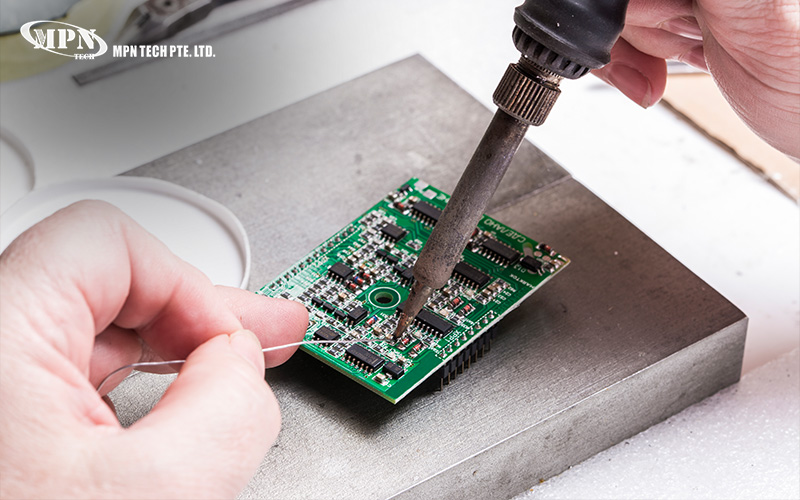
Partnering with contract manufacturers (CMs) who are certified by IPC is an effective way to ensure compliance. Look for vendors that employ Certified IPC Trainers (CITs), as they can train internal teams and maintain up-to-date knowledge of evolving standards. Besides, confirm that your manufacturing partner adheres to the appropriate IPC class level based on your product’s functional and reliability needs.
2. Use IPC-Compliant Design Tools and Libraries
IPC compliance should begin at the design stage. Following guidelines like IPC-2221 helps define key aspects such as layout, spacing, and material selection. Moreover, using ECAD libraries that follow IPC-7351 ensures accurate land pattern and pad sizing for surface-mount components. Meeting IPC standards early in the design phase reduces downstream errors, rework, and delays in manufacturing.
3. Stay Updated with the Latest IPC Revisions
IPC standards are continuously revised to reflect advancements in technology, new manufacturing processes, and emerging materials. It’s important to keep current with the latest IPC documentation and integrate updates into your design and production workflows. Routine internal audits can help identify outdated practices and align your operations with the most recent compliance requirements.
4. Foster Communication and Consistency Across Teams
Not limited to a single department, IPC compliance also requires coordination across engineering, design, and manufacturing teams. Sharing the appropriate IPC class requirements and guidelines keeps every team member on the same page regarding quality expectations and production standards.
In addition, encouraging open communication and ongoing collaboration across departments also promotes a clearer understanding of IPC protocols. This ultimately leads to a final product that meets quality benchmarks and performs as intended.

Frequently Asked Questions
1. Is IPC certification mandatory?
IPC certification is not legally required, but it is highly recommended in professional manufacturing environments. It ensures that engineers, designers, and technicians are trained to apply industry standards correctly.
2. Can IPC standards be applied during the prototyping phase?
Yes. Following IPC guidelines during the prototyping phase helps reduce redesigns, improve product reliability, and ensure a smooth transition to mass production. PCB assembly companies in Singapore are upholding this integrity to maintain consistent quality and performance.
3. How do IPC standards improve quality control?
IPC standards provide clear criteria for acceptability, helping manufacturers and inspectors identify defects, perform consistent inspections, and minimise errors across production runs.
4. What are the most commonly used IPC documents in PCB manufacturing?
Some of the most widely used IPC documents include IPC-A-600 for visual inspection of bare boards, IPC-A-610 for assembly acceptability, IPC-2221 for PCB design, and IPC-7351 for SMD land patterns. These documents serve as essential references throughout the PCB development lifecycle.
5. Why should I choose an IPC-compliant PCB supplier in Singapore?
Working with an IPC-compliant PCB supplier in Singapore ensures your products meet global quality standards. It also provides confidence in the supplier’s ability to deliver consistent, high-performance circuit boards.
Conclusion
IPC standards are the foundation of quality, consistency, and reliability in PCB manufacturing. From design and assembly to inspection and repair, these globally recognised guidelines help reduce errors, streamline production, and ensure that circuit boards meet the performance demands.
For companies seeking a trusted PCB supplier in Singapore, choose MPN Tech, a proven industry leader committed to delivering precision, speed, and innovation. We set ourselves apart with same-day service, flexible customisation options, and a dedicated R&D team.
Contact us to learn more about our services.

 MPN Tech