
Key Takeaways:
Why are PCB Surface Finishes Important?
- They protect exposed copper from oxidation, preserving solderability and extending board shelf life.
- They ensure consistent solder wetting and reliable joint formation across both manual and automated assembly.
- However, each surface finish involves trade-offs in cost, durability, flatness, and long-term reliability that must be carefully evaluated.
Introduction
When designing or manufacturing a printed circuit board (PCB), much of the attention understandably goes to layout, components, and electrical performance. However, an often-overlooked decision that plays a critical role in reliability, manufacturability, and long-term performance is the printed circuit board (PCB) surface finish.
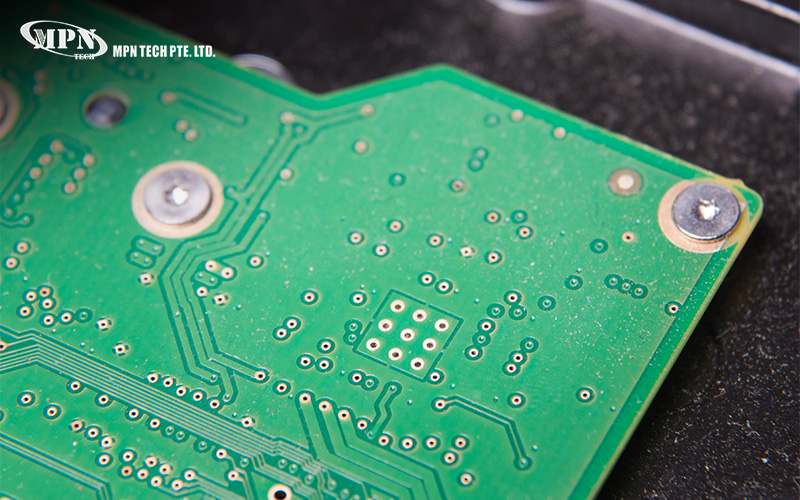
This protective layer is applied to the exposed copper areas of a PCB. It ensures the board’s pads remain solderable and resistant to environmental damage such as oxidation. Without it, even the most carefully designed PCB can suffer from poor solder joints, reduced shelf life, or premature failure.
If you’re working on PCB prototype projects in Singapore or scaling into PCB assembly, understanding the role of surface finishes is essential. Keep reading for further insights.
What are the Common Types of PCB Surface Finishes?
Several surface finishes are commonly used in the electronics industry today. Each has its own strengths and limitations.
1. Hot Air Solder Levelling (HASL)
HASL is one of the most cost-effective options and is widely used for basic boards. It provides good solderability but may result in uneven surfaces, which can be problematic for fine-pitch or high-density designs.
2. Electroless Nickel Immersion Gold (ENIG)
ENIG offers a flat, reliable surface and excellent corrosion resistance. It is well-suited for complex boards and fine-pitch components, though it comes at a higher cost compared to HASL.
3. Organic Solderability Preservative (OSP)
OSP is a thin organic coating that protects copper while maintaining excellent flatness. It is environmentally friendly and cost-effective, but has a shorter shelf life and is more sensitive to handling.
4. Immersion Silver (ImAg)
This finish provides good electrical performance and a flat surface, making it ideal for high-frequency applications. However, it requires careful storage to prevent tarnishing.
5. Immersion Tin (ImSn)
Immersion tin delivers good solderability and a smooth, even surface. If not properly controlled, it may develop tin whiskers that can compromise circuit reliability.
Why PCB Surface Finishes Matter
1. Protects Exposed Copper
Copper oxidises quickly when exposed to air. Oxidation creates a barrier that interferes with soldering and electrical contact. When this barrier forms, solder cannot wet the copper properly, resulting in weak or inconsistent joints that can cause intermittent connections, signal loss, or premature board failure.
A surface finish protects exposed copper pads and traces from oxidation and corrosion, extending the PCB’s usable shelf life. Its functionality is important when boards are stored before assembly or shipped across regions.
2. Ensures Reliable Solderability
A key function of any surface finish is to provide a clean, solder-friendly interface. Proper surface chemistry enables proper solder wetting and intermetallic formation between the solder alloy and the copper pad. This results in mechanically robust joints with low contact resistance and long-term reliability.
Whether components are hand-soldered during prototyping or placed using automated assembly lines, the finish ensures consistent wetting and strong solder joints. This helps minimise variability during assembly and supports repeatable manufacturing outcomes.
3. Supports Different Assembly Requirements
Different projects have different needs based on design complexity, soldering process, storage duration, and end-use conditions. A simple prototype may prioritise cost and speed, while a production board may demand durability, flatness, or compatibility with fine-pitch components.
These factors directly influence surface finish selection, as each finish offers respective performance characteristics in terms of flatness, durability, and process compatibility. Choosing the right one helps align the board’s physical characteristics with its assembly and usage requirements.
4. Understands the Trade-Offs
No single surface finish is “best” for every application. Each option involves trade-offs in cost, durability, environmental compliance, and performance. For example,
- Lower-cost finishes may limit component density or shelf life
- Premium finishes improve reliability but increase production costs
- Some finishes are better suited for prototyping, others for mass production
For teams working on custom PCB assembly, aligning surface finish selection with component type, assembly method, and operating environment is critical. The appropriate finish requires evaluating the board’s design complexity, assembly process, storage conditions, and intended operating environment. Making this decision early helps reduce assembly defects and minimise costly rework later in the product lifecycle.
How to Make the Right Choice for Your PCB Project
A PCB surface finish may seem like a small detail, but it plays a major role in solderability, durability, and overall board quality. By understanding the available options, engineers and project owners can make informed decisions that support both successful prototyping and reliable production.
Selecting an appropriate finish requires balancing technical requirements, budget constraints, manufacturing processes, and long-term reliability expectations to ensure the PCB performs as intended. Once these considerations are clear, the focus shifts to applying them in a practical way when choosing a surface finish for a specific PCB design.
At MPN Tech, we support both manual and automated PCB assembly processes, hybrid assembly for precision electronics, and IPC Class I, II, and III builds. Our expertise helps you make the right surface finish decisions to improve real-world performance, not just theoretical specifications.
Contact us to learn how we ensure smoother transitions from PCB design to production.
 MPN Tech